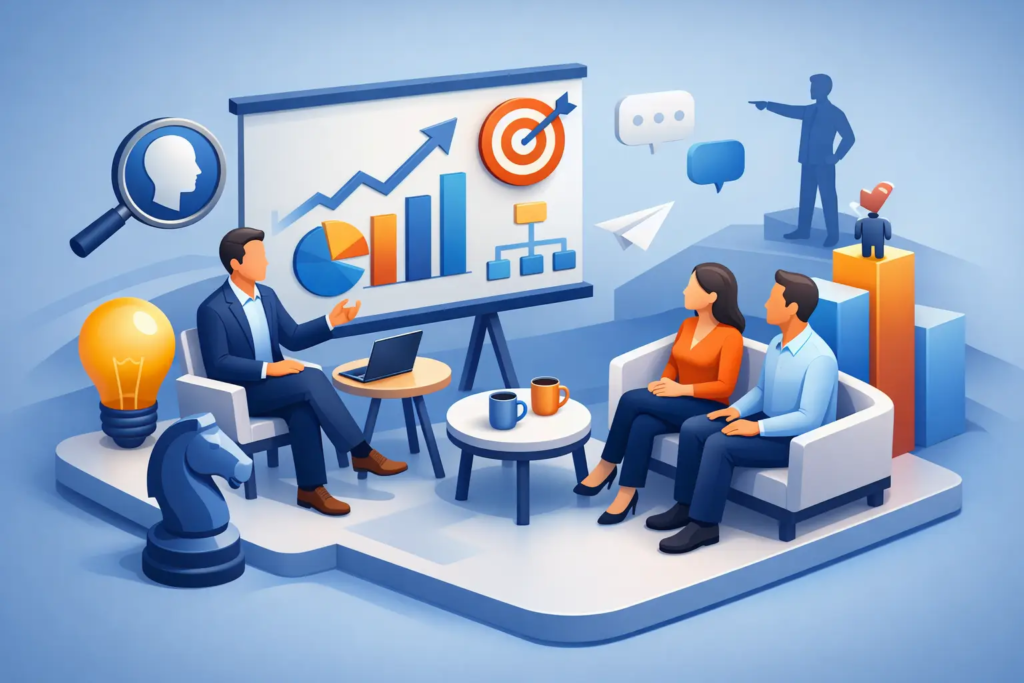
Most ambitious people do not need more information. They need sharper thinking, better decisions and a space where excuses no longer survive. That is what business coaching is really for. If you have been asking what is business coaching, the simplest answer is this: it is a structured, results-focused partnership that helps you improve performance, leadership, decision-making and business growth with far more intention.
But that definition only goes so far. Real business coaching is not a motivational chat, and it is not generic advice handed out from the sidelines. Done properly, it creates measurable movement. It helps business owners, executives and high performers see what is holding them back, make stronger choices and build a business that reflects both commercial success and personal fulfilment.
What is business coaching in practice?
Business coaching is a professional relationship designed to help you achieve a specific business outcome while strengthening the way you think, lead and operate. That outcome might be revenue growth, stronger leadership, a more focused strategy, improved confidence, better team performance or the ability to scale without burning yourself out.
A business coach does not simply tell you what to do. They challenge your assumptions, sharpen your perspective and help you identify the patterns affecting your results. Sometimes the issue is strategic. Sometimes it is behavioural. Very often, it is both.
For high achievers, the real value is not only external progress. It is internal alignment. You can have a sound business model and still sabotage growth through indecision, overthinking, poor boundaries or fear of visibility. Equally, you can be highly motivated but lack the structure to turn potential into consistent results. Business coaching works at the point where mindset, strategy and execution meet.
What business coaching is not
There is confusion around this because the term gets used loosely. Business coaching is not the same as consulting, mentoring or therapy, although there can be some overlap.
A consultant tends to diagnose a business problem and recommend solutions based on specialist expertise. A mentor usually shares guidance from personal experience. Therapy often focuses on healing past issues and emotional recovery. Business coaching is different. It is future-focused, performance-oriented and built around helping you think, act and lead at a higher level.
That said, the best coaching is rarely one-dimensional. If your business growth is being limited by people-pleasing, fear of conflict or chronic self-doubt, those factors cannot be ignored simply because they feel personal. Business results are shaped by the person leading the business. That is why effective coaching often addresses mindset, emotional patterns, leadership style and energy as part of the wider business picture.
Why people seek business coaching
Few successful people seek coaching because they are incapable. Most seek it because they are ready for more. More growth, more clarity, more control, more impact. They know they have reached a point where thinking harder on their own is no longer the answer.
Some clients come to coaching because the business is growing and they need to lead at a new level. Others are stuck. They may be working relentlessly but not seeing the right results. Revenue plateaus, team tensions, unclear positioning and inconsistent confidence can all create a kind of drag that slows progress.
For entrepreneurs, coaching can be especially powerful because the business often mirrors the identity of the founder. When the founder is scattered, hesitant or carrying too much, the business reflects it. For executives, the pressure may look different, but the principle is the same. Leadership performance is shaped by clarity, self-awareness and decision quality under pressure.
How business coaching creates results
The strongest coaching does not rely on hype. It creates results because it improves the quality of your thinking and behaviour over time.
First, it brings clarity. Many business problems look complex until someone asks the right question. A coach helps you separate noise from what actually matters. That can mean refining priorities, challenging a flawed assumption or naming the real issue behind repeated frustration.
Second, it creates accountability. Ambitious people often know what they should be doing, but knowledge without action changes very little. A coach helps you close the gap between intention and execution. Not through pressure for its own sake, but through honest, focused accountability tied to meaningful goals.
Third, it strengthens leadership. This applies whether you lead a company, a small team or simply yourself. Better leadership means clearer communication, firmer decision-making, stronger boundaries and less emotional reactivity. These shifts may sound subtle, but they have a direct effect on culture, growth and profitability.
Fourth, it reveals blind spots. You cannot see your own patterns as clearly from the inside. A skilled coach notices what you normalise, avoid or overcomplicate. That outside perspective is often where the breakthrough happens.
What happens in a business coaching session?
A coaching session should leave you clearer, stronger and more decisive than when you arrived. The exact structure varies, but most sessions focus on a live challenge, a strategic goal or a pattern affecting performance.
You may explore questions such as what is really driving a current bottleneck, why a decision keeps being delayed, where your time is being diluted or which belief is limiting your next level of growth. From there, the session moves towards action. That could mean a clearer strategy, a leadership shift, a more effective plan or a commitment to stop tolerating something that is draining energy and results.
The best sessions are both practical and transformational. They do not stop at inspiration. They move into implementation.
Who benefits most from business coaching?
Business coaching is particularly valuable for people carrying meaningful responsibility. Entrepreneurs, senior leaders, directors, founders and growth-minded professionals often benefit most because the quality of their choices affects more than just their own workload.
It is also powerful for those in transition. Perhaps you are moving from operator to leader, stepping into a more visible role, rebuilding after a setback or preparing for a new phase of growth. These moments demand more than technical skill. They require confidence, emotional steadiness and strategic perspective.
Not everyone is ready for coaching, though. If someone wants a quick fix without reflection or responsibility, coaching will disappoint them. It works best when the client is willing to be honest, coachable and committed to change.
What is business coaching worth for a growing company?
This is where the conversation becomes more practical. Business coaching is worth far more than a set of sessions if it improves how the business performs. Better hiring decisions, stronger pricing, clearer positioning, healthier boundaries, more confident leadership and faster execution all have commercial value.
Yet the return is not always immediate or linear. Some breakthroughs produce visible results quickly. Others build over months as habits change and decisions improve. That is the trade-off many serious clients understand. Good coaching is not magic, but it can dramatically shorten the distance between where you are and where you are capable of going.
It also helps prevent expensive mistakes. Delay, misalignment, poor communication and unmanaged stress all cost money in one form or another. Coaching brings these issues into the light before they become bigger problems.
Choosing the right business coach
This matters more than people realise. A coach may be highly qualified and still be the wrong fit for you. The right coach should be able to challenge you, understand the pressures of high performance and hold both the strategic and human side of growth.
Look for someone who can speak to outcomes, not just inspiration. Ask how they work, what kind of clients they support and whether their style suits the level you operate at. Premium coaching should feel thoughtful, tailored and commercially relevant.
It is also worth paying attention to whether the coach only focuses on tactics. Strategy matters, but if mindset, confidence, communication and energy are ignored, results often plateau. Sustainable success rarely comes from one angle alone. It comes from alignment.
That is why many ambitious clients are now choosing a more integrated coaching model. Hina Solanki Coaching, for example, speaks directly to this need by combining business strategy with mindset transformation, leadership development and energetic alignment. For clients who want success without fragmentation, that approach makes sense.
The deeper value of business coaching
At its best, business coaching changes more than your quarterly figures. It changes the standard you hold for yourself. You become more intentional with your time, more precise in your decisions and less available for patterns that drain your performance.
That does not mean every session feels easy. Sometimes coaching asks you to confront the very habits that helped you get this far but will not take you further. Control, overwork, perfectionism and avoidance can all look productive on the surface. Often, they are not.
The deeper value is that coaching helps you build success you can actually sustain. Not just more output, but more clarity. Not just more money, but more alignment with the life and leadership you want to create.
If you are still asking whether business coaching is worth it, a better question may be this: what would change if you stopped trying to carry your next level alone?