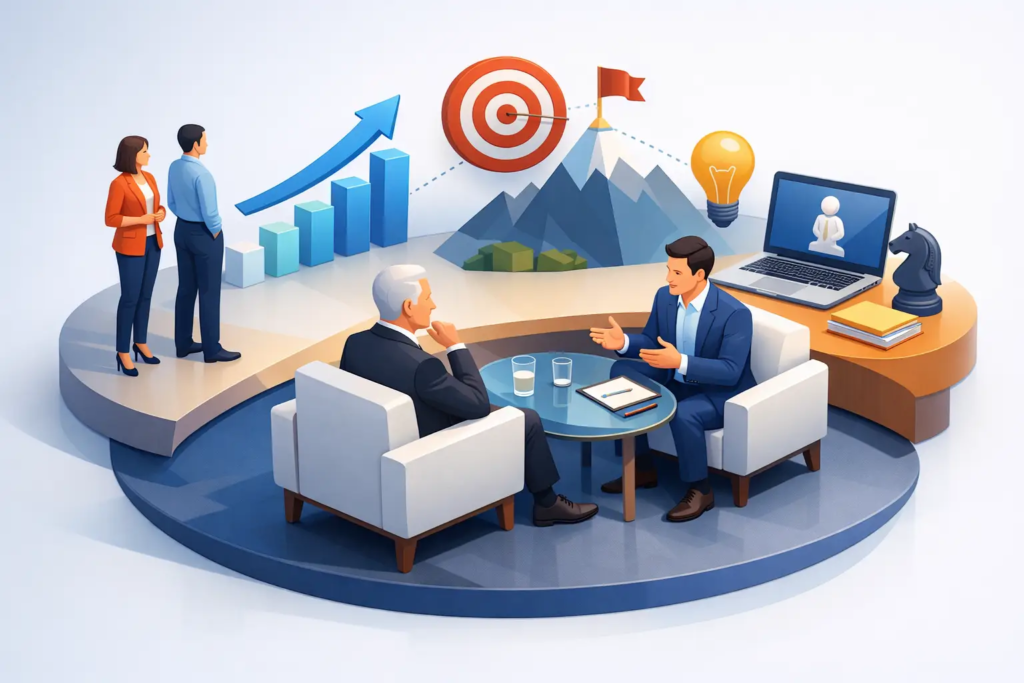
When a senior leader is carrying the weight of growth, performance, people issues and constant decision-making, the challenge is rarely a lack of capability. More often, it is the strain of holding complexity at a high level for a long time. That is where executive coaching for senior leaders becomes powerful. It creates a confidential space to think clearly, lead decisively and expand results without losing yourself in the process.
For many high achievers, success looks strong from the outside while feeling heavy behind closed doors. You may be delivering, earning well and leading a capable team, yet still feel stretched, reactive or disconnected from the version of success you actually want. Senior leadership has a way of magnifying everything – pressure, visibility, responsibility and the cost of unresolved patterns.
The leaders who create extraordinary results over time are not simply working harder. They are making better decisions, managing their energy, communicating with precision and leading from a place of internal alignment. Coaching supports that shift.
Why executive coaching for senior leaders matters
At senior level, the margin for error is smaller and the ripple effect of your leadership is far greater. Your thinking shapes culture. Your emotional state influences teams. Your clarity affects strategy, pace and confidence across the business.
That is why generic development support often falls short. A senior leader does not need motivational platitudes or surface-level advice. They need sharp, strategic support that helps them see what they cannot see alone. They need someone who can challenge blind spots, strengthen decision-making and help them lead in a way that is both commercially effective and personally sustainable.
This is especially true when success has become complex. Perhaps the business is growing but your personal life is paying the price. Perhaps you have reached an impressive level and still feel unfulfilled. Perhaps your role has changed, your team dynamics are shifting or you are preparing for a bigger move and know your current way of operating will not carry you forward.
Coaching meets you at that level of reality. It is not only about performance improvement. At its best, it is about transformation.
What senior leaders really need from coaching
The most effective coaching for senior leaders sits at the intersection of mindset, strategy and energy. If one of those is missing, progress becomes partial.
Strategy matters because senior leaders must think beyond immediate problems. They need to lead with vision, make decisions under pressure and communicate direction with authority. A good coach helps refine this thinking, cut through noise and strengthen execution.
Mindset matters because your internal assumptions drive your external results. Many senior leaders are unconsciously led by pressure patterns that once made them successful – over-responsibility, perfectionism, control, people-pleasing or a constant need to prove themselves. These patterns can look like excellence for a while, but they often create burnout, team bottlenecks and poor-quality decision-making.
Energy matters because leadership is not only intellectual. Your presence changes rooms. Your nervous system affects how you respond to conflict, complexity and challenge. If your energy is scattered, depleted or tense, your leadership will reflect it no matter how strong your credentials are.
This is where a more integrated approach creates exceptional results. When a leader is mentally clear, strategically focused and energetically aligned, they do not just cope better. They lead at a higher level.
The real outcomes of executive coaching for senior leaders
There is a tendency to speak about coaching in vague terms, but high performers want measurable value. They want to know what actually changes.
In practice, the outcomes often show up in several ways. Decision-making becomes faster and more grounded. Communication improves because the leader is no longer second-guessing every conversation. Boundaries become clearer, which reduces overextension and strengthens trust. Teams often perform better because the leader stops rescuing, micromanaging or carrying work that should be delegated.
Coaching also supports the inner side of leadership success. Confidence becomes less performative and more real. Emotional reactions settle. Difficult conversations become easier to handle. The leader starts responding from clarity rather than from stress.
For some, the most valuable shift is fulfilment. They no longer feel that success must come at the expense of peace, health or meaningful relationships. They begin to create a version of achievement that feels powerful and sustainable.
That trade-off matters. There are seasons when intense output is necessary. A major growth stage, a restructure or a high-stakes transition may require more from you. But if intensity becomes your default operating mode, the cost rises over time. Coaching helps leaders build success they can actually live with.
When coaching becomes especially valuable
Not every senior leader seeks support at the same point. Some invest in coaching during crisis, while others do it before the pressure peaks. The second group often moves faster because they are working proactively rather than repairing avoidable damage.
Coaching can be particularly valuable when you are stepping into a bigger role, leading change, navigating board-level pressure or feeling the strain of sustained performance. It is also highly effective when your external success has outgrown your internal capacity to hold it with confidence.
That might sound surprising, but it is common. A leader can be commercially successful and still feel anxious, overextended or privately uncertain. They may have mastered delivery but not yet mastered sustainable leadership. They may be highly respected but still disconnected from their own sense of fulfilment.
Support at this level is not a sign that something is wrong. It is a sign that you are ready for a more expanded way of leading.
What to look for in executive coaching for senior leaders
Not all coaching is equal, and senior leaders should be discerning. Credentials matter, but so does depth. You need a coach who understands performance, human behaviour and the realities of leadership at a senior level.
Look for someone who can challenge you rather than simply affirm you. Someone who can hold confidentiality, think strategically and help you see both the practical and emotional dynamics at play. A coach should be able to support business outcomes without ignoring the human being responsible for delivering them.
This matters because leadership problems are rarely only operational. A communication issue may be a confidence issue. A delegation issue may be a control issue. A burnout issue may be linked to identity, self-worth or an inability to switch off from achievement.
A premium coaching relationship addresses the whole picture. It helps you improve results while also changing the patterns that limit your expansion.
For leaders who want more than surface-level performance support, this integrated model is often the difference between temporary improvement and lasting transformation. That is why businesses such as Hina Solanki Coaching position executive coaching as both strategic and holistic. The strongest results come when high performance is matched by inner alignment.
The leadership shift that changes everything
There is a pivotal moment in many senior careers where working harder stops being the answer. More effort no longer creates more ease, more impact or more fulfilment. At that point, the next level requires a different way of leading.
It requires greater self-awareness, stronger boundaries, better strategic thinking and a calmer internal state. It requires the ability to influence without force, decide without panic and grow without sacrificing your wellbeing. That shift is not always achieved through experience alone. Sometimes experience reinforces habits that need to be broken.
Coaching accelerates this evolution. It helps senior leaders lead from intention rather than conditioning. It creates space for honest reflection, better choices and meaningful change. And because the stakes are higher at senior level, that change often has a wide effect – on business growth, team performance, personal confidence and quality of life.
If you are leading at a high level and know you are capable of more, the question is not whether you can keep pushing. It is whether you are ready to lead with greater clarity, power and alignment. That is where the real expansion begins.