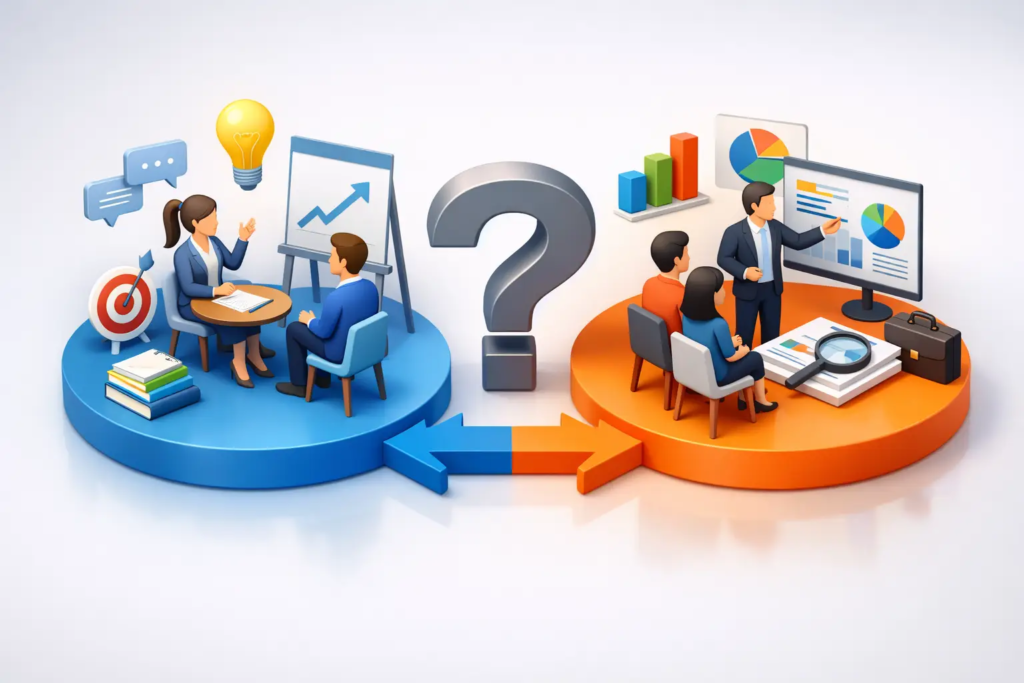
One founder wants sharper strategy. Another wants to stop second-guessing every decision, lead with more authority, and grow without burning out. Both are asking for support, but they do not need the same kind of help. That is where business coaching vs consulting becomes a serious decision, not a semantic one.
If you are ambitious, capable, and already operating at a high level, choosing the wrong support can slow your progress. You might hire a consultant when what you really need is stronger leadership, better decision-making, and internal clarity. Or you might choose a coach when your business actually needs specialist diagnosis and an external plan. The difference matters because the right intervention creates momentum. The wrong one creates dependency, delay, or expensive noise.
Business coaching vs consulting: the core difference
At the simplest level, a consultant usually tells you what to do. A coach helps you become the person who can do it exceptionally well.
Consulting is primarily advice-led. A consultant is brought in to assess a problem, identify opportunities, and recommend actions based on experience or expertise in a particular area. That could be operations, sales, finance, marketing, systems, scaling, or organisational change. Their value often lies in speed, objectivity, and specialist knowledge.
Business coaching is different. A business coach is less focused on handing you a ready-made answer and more focused on strengthening your thinking, leadership, confidence, behaviour, and performance so that you can create the right answer and execute it consistently. The work often includes mindset, decision quality, communication, accountability, emotional intelligence, visibility, resilience, and alignment between business goals and personal fulfilment.
For high performers, this distinction is powerful. One model transfers expertise. The other expands capability.
What a consultant is really there to do
A strong consultant enters with perspective. They look at your business from the outside, often with technical or sector-specific insight, and identify what is missing, broken, inefficient, or underperforming. Then they make recommendations, and in some cases help implement them.
If your sales process is leaking revenue, your team structure no longer fits your stage of growth, or your systems are failing under pressure, consulting can be the fastest route to clarity. You are paying for precision, pattern recognition, and solutions that have worked before.
This can be invaluable when the issue is practical and defined. If you need market-entry strategy, pricing analysis, a restructuring plan, or support preparing for investment, a consultant may be exactly right.
The trade-off is that consulting can stop at strategy. Even when the recommendations are excellent, results still depend on whether you and your team can implement them. If the real issue is avoidance, weak leadership, poor boundaries, people-pleasing, lack of confidence, or a founder who is emotionally exhausted, no slide deck will fix that.
What business coaching is designed to change
Business coaching works at a deeper performance level. It addresses not only what is happening in your business, but who you are being while it is happening.
That matters more than many leaders realise. Businesses rarely stall only because of tactics. They stall because the person leading them is carrying self-doubt, conflict avoidance, unclear priorities, reactive habits, or success patterns that no longer fit the next level. Coaching brings those patterns into the light and changes them.
The best coaching is not vague encouragement. It is structured, honest, and results-focused. It helps you think strategically, communicate clearly, set stronger standards, and act in alignment with the results you say you want. It also creates space for the human side of success – energy, fulfilment, relationships, confidence, and emotional steadiness – because these factors shape performance far more than most businesses admit.
This is especially relevant for entrepreneurs, executives, and senior professionals who are outwardly successful but inwardly stretched. You may have revenue, responsibility, and momentum, yet still feel stuck in overthinking, pressure, or misalignment. Coaching helps you create sustainable excellence rather than external achievement at personal cost.
When consulting is the better choice
There are moments when you do not need someone to coach your thinking. You need someone who knows the terrain better than you do and can show you the most effective route.
If your challenge is specific, technical, and time-sensitive, consulting is often the better fit. Perhaps you need an operational turnaround, a go-to-market plan, a pricing strategy, compliance guidance, or a clearer growth model. In these cases, you are buying expertise that shortens the learning curve.
Consulting also makes sense when internal capability is missing. If no one in your business has solved this particular problem before, there is value in borrowing experience rather than reinventing the process through trial and error.
Even so, be careful not to outsource ownership. A consultant can provide a strategy, but they cannot replace your leadership. If you keep seeking external answers without building internal strength, the business may improve on paper while you remain the bottleneck.
When business coaching is the better choice
Business coaching is often the stronger choice when the business challenge is inseparable from the person leading it.
If you know what to do but are not doing it consistently, that is usually not a consulting problem. If your growth is being limited by visibility fears, poor delegation, imposter syndrome, lack of direction, leadership strain, or difficulty making clean decisions, coaching is the more transformative route.
It is also the right fit when success itself has become complicated. Many high achievers reach a point where they no longer want growth that comes with constant stress, fractured relationships, or a nervous system that never settles. They want bigger results, but they want them with clarity, confidence, and alignment. Coaching supports that shift.
This is where a more integrated approach stands apart. Hina Solanki Coaching, for example, speaks to leaders and entrepreneurs who do not want to choose between wealth, wellbeing, fulfilment, and impact. That broader lens matters because real success is not one-dimensional.
The hidden issue: many businesses need both
The truth is that business coaching vs consulting is not always an either-or decision. Sometimes the strongest growth happens when both are used deliberately.
A consultant might help you define the commercial strategy, while a coach helps you become the leader who can deliver it. A consultant can identify the systems and structure required for scale, while a coach supports the mindset, energy, and communication needed to hold that level of responsibility.
This combination is often where breakthroughs happen. One gives you an external framework. The other develops your internal capacity.
Still, timing matters. If you are in acute operational trouble, consulting may need to come first. If the same behavioural patterns are repeating across every strategy, coaching may be the priority. The smartest decision is not the one that sounds more impressive. It is the one that addresses the real constraint.
How to decide what you need right now
Ask yourself a harder question than, “Which service is better?” Ask, “What is actually stopping results?”
If the answer is a lack of specialist knowledge, a flawed process, poor market positioning, weak financial planning, or inefficient systems, consulting is likely the better investment.
If the answer is hesitation, overwhelm, inconsistency, fear of visibility, leadership friction, diluted focus, low confidence, or a growing gap between your ambition and your current capacity, coaching is likely the better investment.
And if you find yourself saying, “I know the strategy, but I am still not moving,” take that seriously. Knowledge is not always the missing piece. Often, the breakthrough comes from changing the way you think, lead, decide, and hold yourself.
The result you should expect from either
Whether you choose coaching or consulting, the benchmark is not activity. It is transformation.
Good consulting should create sharper decisions, stronger systems, and measurable business improvement. Good coaching should create deeper clarity, stronger leadership, better execution, and a more sustainable experience of success.
Neither should leave you more confused, more dependent, or endlessly circling the same conversation. Premium support should move you forward.
The most successful people are not afraid to get help. They are simply more discerning about the kind of help they choose. If you select support that matches the true source of the problem, growth becomes cleaner, faster, and far more aligned with the life and business you actually want to build.
Choose the path that strengthens not only your results, but your capacity to hold them.