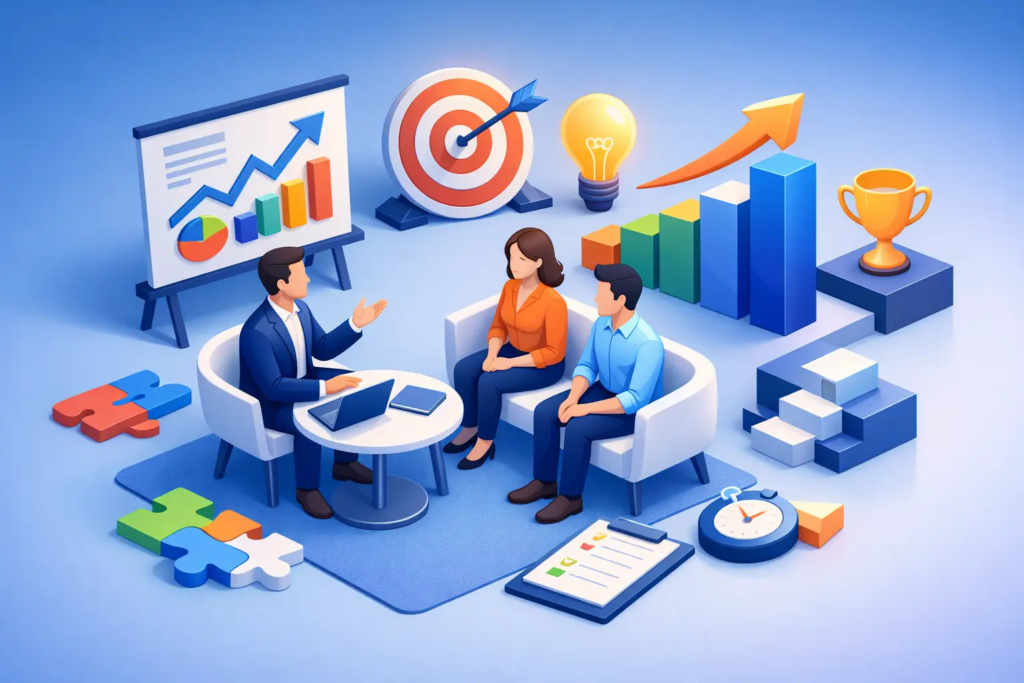
A team rarely underperforms because people suddenly stop caring. More often, performance slips when pressure rises, priorities blur, confidence drops, and talented people start operating in survival mode instead of at their highest level. That is where corporate coaching for employee performance becomes powerful. It does not just push people harder. It helps them think better, lead themselves more effectively, and perform with greater clarity, resilience, and purpose.
For ambitious organisations, that distinction matters. Short-term pressure can create activity, but it rarely creates sustainable excellence. If you want employees who take ownership, communicate well, make stronger decisions, and stay engaged while delivering results, coaching offers a very different route from traditional performance management.
What corporate coaching for employee performance actually changes
The strongest coaching programmes do far more than address surface-level productivity. They work at the level where performance is created – mindset, behaviour, emotional regulation, communication, leadership presence, and personal accountability.
An employee can have the right technical skills and still struggle to perform consistently. They may avoid difficult conversations, hesitate when making decisions, lose focus under pressure, or carry stress that affects their confidence and output. In many businesses, these issues are misread as attitude problems or capability gaps. In reality, they are often coaching issues.
Corporate coaching creates space to identify what is really driving underperformance. Sometimes it is a confidence issue. Sometimes it is unclear expectations. Sometimes it is a leader who has been promoted without support. Sometimes it is a high-potential employee whose internal pressure is now working against them.
When coaching is done well, people do not just feel better. They perform better because they start thinking with more intention. They communicate more clearly, manage energy more intelligently, and respond to challenge with greater maturity.
Why high-performing businesses invest in coaching
The best organisations understand that performance is never only about systems and targets. It is also about people’s internal state. You can have a strong strategy, a capable workforce, and clear KPIs, yet still see inconsistent delivery if employees are overwhelmed, disengaged, or misaligned.
Coaching helps close that gap. It supports people in translating potential into measurable action. That might look like a manager becoming more decisive, a team member improving stakeholder relationships, or a senior leader learning to regulate stress before it affects the wider team.
This is especially relevant in businesses where expectations are high. High achievers often look composed on the outside while carrying hidden pressure underneath. They may be productive but not sustainable. They may be successful but not fully aligned. If left unaddressed, that tension can lead to burnout, disengagement, strained relationships, or a gradual drop in performance that no dashboard explains clearly.
Coaching offers a more intelligent intervention. Rather than waiting for problems to escalate, it develops the inner and strategic capacities that support long-term excellence.
The link between mindset, energy and results
Employee performance is often discussed in operational terms, but human performance is more layered than that. Focus, confidence, self-belief, emotional stability, and energy all affect output.
A person who is mentally scattered will struggle to prioritise. A person who doubts their own value may avoid visibility or responsibility. A leader who is emotionally reactive can damage trust even if they are commercially strong. This is why a purely tactical development approach often falls short.
Real transformation happens when coaching addresses both performance strategy and the internal patterns shaping behaviour. That is where premium coaching brings a different level of value. It does not separate productivity from mindset, or leadership from personal alignment. It recognises that people perform at their best when they are clear, confident, accountable, and energetically resourced.
That does not mean every workplace challenge is solved through mindset alone. Structural issues still matter. Poor management, unrealistic workloads, and unclear roles cannot be coached away. But where capable people are being held back by stress, self-doubt, communication gaps, or inconsistent leadership habits, coaching can create significant movement.
What effective coaching looks like inside an organisation
Not all corporate coaching is equal. Some programmes feel generic, polite, and quickly forgotten. Others create visible change because they are tailored, commercially aware, and grounded in measurable outcomes.
Effective coaching starts with clarity. What is the business trying to improve? That could be leadership capability, employee confidence, accountability, team communication, retention, or readiness for growth. From there, the coaching needs to connect organisational priorities with individual transformation.
For one employee, that may mean strengthening executive presence and decision-making. For another, it may mean managing pressure, communicating boundaries, and improving consistency. For a leadership team, it may mean creating stronger alignment, greater trust, and a more empowering management culture.
The key is relevance. Coaching should never feel detached from day-to-day business reality. It needs to help people perform better in the conversations, decisions, and challenges they are facing now.
Where coaching delivers the biggest performance gains
The greatest impact is often seen in moments of stretch. A newly promoted manager, a founder building a stronger leadership team, a senior executive carrying complex responsibility, or a talented employee who is ready for more but not yet fully stepping into their capability.
These are the points where people need more than instruction. They need support that helps them think at a higher level, move through internal resistance, and lead with greater confidence.
Coaching is also highly effective during periods of change. Growth, restructuring, increased targets, and cultural shifts can all expose performance weaknesses that were previously hidden. Some employees rise quickly. Others become cautious, overwhelmed, or disconnected. Coaching helps people stabilise, adapt, and lead themselves through uncertainty.
There is a trade-off to acknowledge here. Coaching is not the fastest fix if the issue is purely technical or procedural. If employees lack clear training or systems, start there. But if the challenge is behavioural, relational, or rooted in mindset, training alone will not create lasting change.
How to choose the right corporate coaching approach
If your goal is stronger employee performance, the right coaching partner should be able to speak the language of both results and transformation. That means understanding commercial pressure while also recognising the human drivers behind performance.
Look for an approach that is bespoke rather than generic. Employees at different levels need different support, and senior people in particular require coaching that respects complexity, confidentiality, and ambition. A one-size-fits-all workshop may create a short burst of motivation, but it rarely changes entrenched patterns.
It also helps to choose a coach who can work beyond surface behaviour. Sustainable performance improves when people develop emotional intelligence, personal responsibility, strategic clarity, and stronger self-leadership. For many organisations, that integrated approach creates the deepest return because it affects not only what employees do, but how they show up while doing it.
This is where firms such as Hina Solanki Coaching stand out. The value is not just in helping people hit goals. It is in helping them align mindset, strategy, and energy so high performance becomes more natural, sustainable, and expansive.
Measuring success without reducing people to metrics
Businesses understandably want evidence that coaching works. That evidence can include improved retention, stronger engagement, better communication, increased confidence in leadership, higher productivity, or progress against specific objectives.
Yet the full impact of coaching is not always visible in a spreadsheet immediately. Sometimes the shift appears first in the quality of conversations, the speed of decision-making, or the way a manager handles pressure. Those changes often lead the measurable business outcomes that follow.
The most useful evaluation combines hard and soft indicators. Track performance goals, but also pay attention to confidence, accountability, collaboration, and resilience. Those are not vague qualities. They are often the foundations of commercial success.
Performance without burnout
There is a difference between extracting more from employees and elevating how they perform. The first approach can produce quick wins and long-term cost. The second builds capability that lasts.
Corporate coaching for employee performance is most effective when it supports ambition without sacrificing wellbeing. People do their best work when they are challenged, yes, but also when they have clarity, emotional steadiness, and a sense of meaning in what they are building.
That is the future-facing conversation many organisations need to have. Not how to get more hours, more pressure, or more compliance, but how to create workplaces where people can perform exceptionally well because they are developed as whole human beings, not treated as output machines.
When you invest in that level of growth, performance stops being a constant struggle to manage. It starts becoming a standard your people are genuinely equipped to sustain.