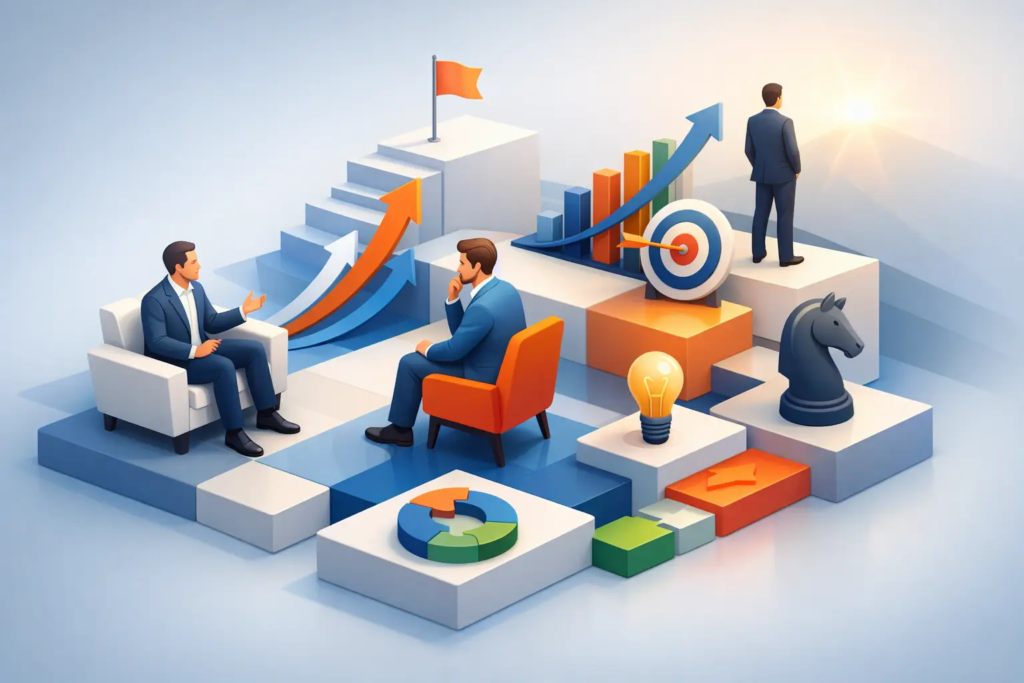
When a senior leader looks successful on paper but feels stretched, reactive or quietly disconnected, the issue is rarely capability. More often, it is misalignment. Executive coaching creates the space to think clearly, lead decisively and perform at a higher level without sacrificing fulfilment in the process.
For high achievers, pressure can become normal so quickly that stress starts to masquerade as ambition. You keep delivering, keep solving, keep carrying responsibility, yet the quality of your thinking drops. Relationships can feel strained, your energy becomes inconsistent, and the version of success you worked hard to build no longer feels as rewarding as it should. That is usually the moment coaching stops being a luxury and starts becoming a serious strategic investment.
What executive coaching really does
At its best, executive coaching is not advice dressed up as development. It is a focused, confidential partnership designed to sharpen leadership, strengthen decision-making and remove the internal patterns that limit performance. The practical side matters – better communication, stronger delegation, clearer strategic thinking, improved stakeholder management. But lasting transformation goes deeper than technique.
Senior professionals do not usually need more information. They need precision. They need to see where they are overcompensating, where fear is driving control, where success has become performative, or where exhaustion is quietly narrowing their vision. Coaching helps bring those patterns into the open so that leadership becomes more intentional, influential and effective.
This is where many conventional approaches fall short. They may help someone refine a presentation style or prepare for a promotion, but they do not always address the underlying drivers of behaviour. If mindset remains constrained, if emotional pressure remains unmanaged, or if a leader is chronically out of alignment with their values and energy, results can improve briefly and then plateau.
True executive growth comes from integration. Strategy matters. Mindset matters. Emotional intelligence matters. Energy matters too, because depleted leaders do not make their best decisions, no matter how experienced they are.
Why executive coaching matters more at senior level
The higher you rise, the less honest feedback you tend to receive. Teams may hesitate to challenge you. Peers may be competing with you. Boards often want certainty, not vulnerability. That creates a leadership gap where external success can sit alongside internal pressure, and very few people see the full picture.
Executive coaching closes that gap. It gives leaders a private space to test ideas, face blind spots and think beyond immediate demands. That matters because senior roles are rarely difficult for one reason alone. There may be commercial pressure, people issues, visibility, personal expectations, family commitments and the constant demand to perform at speed. If one area slips, the effect is rarely contained.
For entrepreneurs and founders, the challenge is often even more personal. The business can become an extension of identity. Every setback feels amplified. Every growth decision carries financial, emotional and relational consequences. Coaching helps create separation between who you are and what you are managing, which often leads to calmer leadership and better choices.
The shifts strong leaders often need most
Many ambitious people assume coaching is for fixing weakness. In reality, it is often most valuable for those already operating at a high level. They are not failing. They are simply ready for a more powerful way of leading.
One common shift is moving from constant doing to deliberate leadership. Some executives have built success through effort, speed and control. That can work for a while, but eventually it creates bottlenecks. A leader who cannot step back, trust others or think strategically will cap both personal capacity and business growth.
Another shift is from external validation to internal certainty. Plenty of accomplished professionals still measure themselves through approval, titles or visible achievement. The cost is subtle but significant. Decisions become slower, confidence becomes conditional, and leadership loses its edge. Coaching helps build a deeper foundation of self-trust so that presence and performance are not dependent on applause.
Then there is the shift from fragmented success to whole-life success. A leader may be excelling commercially while feeling disconnected personally. They may be building wealth while neglecting health, relationships or peace of mind. That is not sustainable excellence. It is strain with good branding. Real success has to hold under pressure and still feel meaningful.
Mindset, strategy and energy are not separate
One reason executive coaching can be transformational is that it addresses the full system behind performance. A leader’s results are shaped not only by business decisions, but by the quality of their thinking, emotional patterns and energetic state.
Mindset influences how you interpret risk, respond to challenge and handle visibility. Strategy determines where you focus, what you prioritise and how you convert ambition into action. Energy affects consistency, presence and resilience. Ignore one of these, and progress becomes harder than it needs to be.
Take delegation as an example. On the surface, it looks like a time-management issue. In practice, it may be linked to perfectionism, fear of losing standards, distrust, identity or control. A practical tool can help, but if the deeper pattern is left untouched, the leader often reverts under pressure. Coaching works because it deals with both the visible behaviour and the hidden driver.
This integrated approach is especially relevant for ambitious professionals who want more than surface improvement. They want expansion that feels grounded. They want strong results, but not at the cost of themselves.
What to expect from an executive coaching process
A meaningful coaching process should create measurable change, not vague reflection. That does not mean every outcome can be reduced to a spreadsheet, but progress should be visible in the way a leader thinks, decides, communicates and performs.
Early sessions often focus on clarity. What does success actually look like now? Not three promotions ago, not according to someone else’s definition, but at this stage of life and leadership. That question matters because many executives are still chasing goals they have outgrown.
From there, the work tends to uncover friction points. These may include imposter patterns, burnout, poor boundaries, indecision, underdeveloped confidence, conflict avoidance or difficulty influencing at a higher level. Some issues are practical. Others are emotional. Usually, they are connected.
The strongest coaching relationships combine challenge with support. You need someone who can help you think bigger, spot excuses quickly and hold you to a higher standard. But you also need a process that respects complexity. Leadership is not linear. Sometimes the right move is bolder action. Sometimes it is restraint, recovery or a reset.
For organisations investing in coaching, this is where the real value appears. Leaders become more effective, but they also become more self-aware, more resilient and more capable of creating high-performance cultures. Better leadership ripples outward.
Choosing the right executive coaching support
Not every coach is right for every leader. Chemistry matters, but substance matters more. A premium coaching experience should offer depth, confidentiality, strategic intelligence and the ability to work at the level the client is operating.
If a coach only focuses on motivation, the work may feel uplifting but shallow. If they only focus on business tactics, they may miss the internal barriers driving underperformance. The strongest support brings both dimensions together. It understands ambition and pressure. It can speak the language of results while also recognising that clarity, confidence and alignment are not soft extras. They are performance assets.
This is particularly important for executives and entrepreneurs who are used to being the strongest person in the room. They do not need flattery. They need insight, challenge and a trusted space to recalibrate. That is part of why firms such as Hina Solanki Coaching resonate with ambitious clients seeking measurable transformation rather than generic encouragement.
It is also worth being realistic. Coaching is powerful, but it is not magic. It will not replace accountability, difficult conversations or disciplined execution. The best outcomes come when leaders are ready to be honest, willing to act and committed to change beyond the session itself.
Executive coaching and the future of leadership
The leadership model built on endurance alone is fading. Being constantly available, permanently stressed and privately depleted is not a badge of excellence. It is a warning sign. Modern leadership requires sharper thinking, stronger emotional regulation and the capacity to lead with both authority and alignment.
That does not mean every leader must adopt the same style. Some will become more visible and assertive. Others will become calmer, more spacious and more selective. Executive coaching is not about turning people into a polished template. It is about helping them lead from their highest level of truth, strength and effectiveness.
For some, that means stepping into bigger rooms with more confidence. For others, it means rebuilding trust, setting boundaries or reconnecting with the reason success mattered in the first place. The path is personal, but the pattern is consistent: when leaders gain clarity, strengthen mindset and regulate energy, results improve.
If you are already delivering but know there is another level available to you, pay attention to that instinct. The next breakthrough is not always found by pushing harder. Sometimes it comes from leading in a way that is more conscious, more strategic and more fully aligned with who you are becoming.