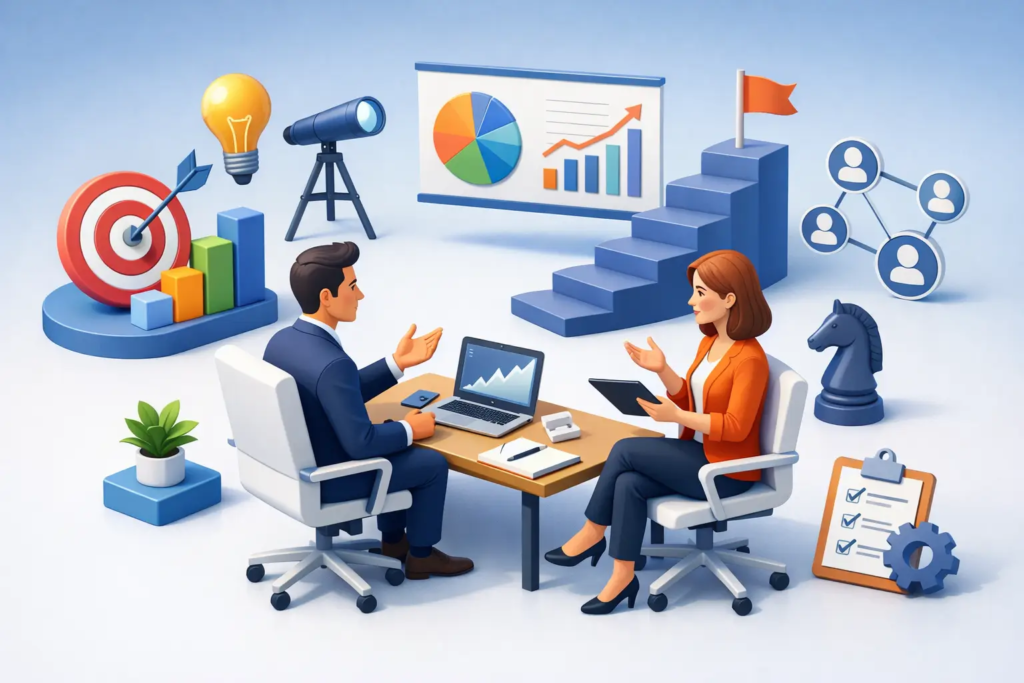
When a senior leader is delivering on paper but feels stretched, reactive or quietly off course, the issue is rarely capability. More often, it is a gap between performance and alignment. That is where an executive performance coaching guide becomes genuinely useful – not as theory, but as a clear framework for better decisions, stronger leadership and sustainable success.
At executive level, the cost of operating in survival mode is high. It shows up in inconsistent communication, avoidable tension, slower thinking under pressure and a version of success that looks impressive from the outside but feels draining to sustain. Coaching done well does not simply help someone work harder. It helps them lead with greater precision, self-awareness and energy, so results improve without sacrificing fulfilment.
What executive performance coaching really means
Executive performance coaching is often misunderstood as a corrective tool for underperforming leaders. In reality, the best coaching is usually sought by ambitious people who are already achieving, but know they are capable of more. They want sharper thinking, stronger presence, cleaner execution and the capacity to lead at a higher standard.
This kind of coaching sits at the intersection of mindset, strategy and behaviour. It helps an executive identify what is limiting performance, but it also addresses what is fragmenting focus. Sometimes the issue is practical – poor delegation, unclear priorities, weak boundaries or inconsistent accountability. Sometimes it runs deeper – fear of visibility, perfectionism, internal pressure, difficulty trusting others or a success model that has outgrown its usefulness.
That is why high-level coaching must go beyond surface productivity. If a leader is outwardly successful but inwardly exhausted, the problem is not solved by another planning tool. Sustainable performance comes from alignment between identity, leadership style, decision-making and energy.
Why an executive performance coaching guide matters now
The demands placed on executives have changed. Leaders are expected to deliver commercial results, maintain team morale, communicate with emotional intelligence and make high-stakes decisions in fast-moving conditions. Many are also balancing business growth with personal commitments, health concerns and a constant stream of demands on their attention.
In that environment, experience alone is not enough. Leaders need space to think clearly, challenge blind spots and recalibrate before pressure becomes dysfunction. A strong executive performance coaching guide matters because it helps distinguish between temporary pressure and structural patterns that are quietly reducing impact.
It also brings one crucial truth into focus: high performance is not the same as constant output. Some executives have built success through force, speed and self-pressure. That can work for a season, but it often creates diminishing returns. Better leadership comes from clarity, emotional regulation, strategic confidence and the ability to influence without depletion.
The core areas coaching should improve
The most effective coaching creates measurable movement in both internal and external performance. It should improve how a leader thinks, leads and executes.
Clarity is usually the first shift. Executives often have too many competing priorities, too much noise and not enough space for strategic thought. Coaching helps separate urgency from importance, making it easier to focus on the decisions that genuinely move the business forward.
Confidence is another major area. Not the performative kind, but grounded confidence. The sort that allows a leader to communicate decisively, hold standards, navigate challenge and trust their judgement without second-guessing every move.
Then there is leadership presence. This can be difficult to define, but everyone recognises it when it is there. It shows in the way someone enters a room, handles pressure, speaks with authority and creates trust. Presence is not about volume or charisma. It comes from self-command.
Execution matters too. Coaching should sharpen follow-through, delegation, accountability and decision-making. If insight never becomes action, the coaching has limited value. Real transformation must show up in performance metrics, team dynamics, commercial outcomes or quality of life.
For some leaders, resilience is the missing piece. Not the kind that glorifies endurance, but the kind that supports calm, perspective and consistency. Resilience allows an executive to stay effective without becoming emotionally brittle.
How to choose the right executive performance coaching approach
Not every coaching model is suited to senior leaders. Some approaches are too generic. Others focus heavily on motivation without addressing strategy, leadership behaviour or internal patterns. The right fit depends on the executive’s role, goals and current level of pressure.
A useful starting point is to ask what the leader actually needs. If the challenge is promotion into a bigger role, coaching may need to focus on visibility, influence and executive presence. If the challenge is business growth, strategic thinking and decision-making may take centre stage. If success has come with stress, disconnection or burnout risk, the work must include mindset, emotional regulation and energy management.
That is where a more integrated model stands out. Leaders are not machines. They do not perform at their best when one part of life is thriving and the rest is quietly collapsing. Coaching that addresses only tactics can create short-term improvement, but deeper, longer-lasting results often require work on beliefs, behaviours, relationships and personal alignment as well.
This is especially relevant for high achievers who have outgrown old identities. A leader may still be using the habits that helped them succeed earlier in their career – over-delivering, controlling outcomes, proving worth through effort – even though those habits now limit scale. Coaching helps replace old strategies with a more powerful way of leading.
What a strong coaching process looks like
The process should be challenging, tailored and outcomes-led. It is not a series of pleasant conversations. It should create insight, but also momentum.
A strong engagement usually begins with honest assessment. What is working? What is not? Where is performance leaking? What patterns keep repeating? This stage needs candour, because executives are often praised more than they are truthfully challenged.
From there, the coaching should establish clear goals. These might include improving board-level influence, leading a team through change, reducing decision fatigue, increasing profitability, managing conflict more effectively or rebuilding confidence after a difficult period. Specificity matters because vague coaching leads to vague results.
The next stage is intervention. This is where the coach helps the client shift thinking, test assumptions, develop new behaviours and stay accountable. Sometimes the work is practical and immediate. Sometimes it requires deeper reflection. The best coaching knows when to challenge performance habits and when to address the inner drivers behind them.
Progress should be visible over time. That may mean stronger communication, better delegation, greater calm under pressure, healthier boundaries or improved commercial performance. It may also mean something less visible but equally important: the leader feeling clear, centred and fully in command again.
The trade-offs leaders need to understand
There is no single formula for executive growth. What works for one leader may not suit another. A fast-paced, direct coaching style may benefit an experienced founder but overwhelm someone already carrying too much pressure. Equally, reflective coaching can be powerful, but if it lacks structure, it may not create results quickly enough.
There are trade-offs in leadership too. Greater visibility can invite greater scrutiny. Stronger boundaries may disappoint people who benefitted from over-access. Better delegation may initially feel slower than doing everything personally. Growth often asks a leader to tolerate short-term discomfort in service of long-term expansion.
This is why coaching should never promise a frictionless process. Transformation is rewarding, but it is not always comfortable. The value lies in making change intentional, rather than waiting for stress or stagnation to force it.
Executive performance coaching guide for lasting success
The strongest leaders are not those who simply endure more pressure. They are the ones who know how to elevate performance while staying connected to purpose, standards and self-trust. An executive performance coaching guide is valuable when it helps a leader do exactly that.
For ambitious professionals, entrepreneurs and senior decision-makers, the goal is not just to achieve more. It is to achieve at a higher level without fragmentation. That means building success from clarity instead of chaos, from aligned leadership instead of constant compensation.
This is where premium coaching can create measurable transformation. When mindset, strategy and energy are all addressed, leaders stop managing symptoms and start creating real change. Hina Solanki Coaching speaks to this more complete standard of success – one where performance, fulfilment and leadership excellence are not competing priorities, but part of the same evolution.
If you are already successful but know your next level requires a different way of thinking and leading, trust that instinct. The most powerful shift often begins when you stop asking how much more you can carry and start asking what would change if you led from greater clarity, confidence and alignment.