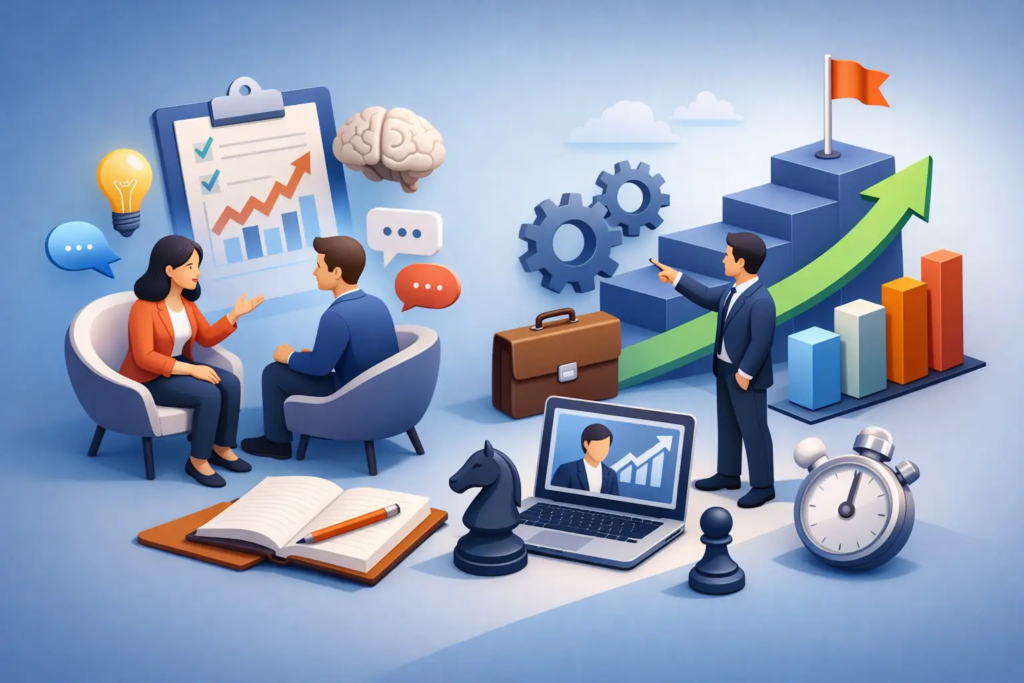
Success can look impressive from the outside and still feel misaligned on the inside. Many high achievers reach a point where the income is growing, the responsibilities are expanding, and the pressure is constant, yet clarity, confidence, and fulfilment are not keeping pace. That is exactly why a personal and business coaching guide matters. The right coaching does not simply help you perform better at work or feel better in your private life. It helps you create results that are sustainable because they are built from alignment, strategy, and self-leadership.
What a personal and business coaching guide should actually help you solve
If you are ambitious, you rarely have just one challenge. You may be leading a team while managing strain at home. You may be growing a business while battling self-doubt, inconsistency, or exhaustion. You may be outwardly successful but privately frustrated that your next level still feels harder than it should.
This is where many people choose the wrong kind of support. They look for business advice when the real block is identity. Or they focus on mindset alone when the missing piece is commercial strategy, leadership structure, or sharper decision-making. Personal and business coaching works best when it sees the whole picture.
A strong coaching process connects the internal and external drivers of success. That means your thinking, emotional state, habits, boundaries, relationships, energy, leadership style, and strategic actions are treated as linked rather than separate. When those elements are out of step, progress feels heavy. When they are aligned, momentum builds faster and with far less friction.
Personal and business coaching guide: what coaching includes
At its best, coaching is not vague encouragement. It is a focused, results-led partnership designed to move you from where you are now to where you know you are capable of being.
Personal coaching tends to address confidence, clarity, purpose, emotional resilience, relationships, fulfilment, self-worth, and the patterns that keep you stuck. Business coaching focuses more on growth, leadership, performance, decision-making, visibility, productivity, team dynamics, and commercial direction. Executive coaching often sits between the two, helping senior leaders perform at a higher level without sacrificing wellbeing or presence.
In practice, these areas overlap. A founder struggling to scale may need stronger systems, but also cleaner boundaries and greater trust in delegation. An executive aiming for the next promotion may need stronger influence, but also the confidence to be more visible. A professional who wants more fulfilment may need a career shift, but also the courage to stop performing a version of success that no longer fits.
That overlap is where integrated coaching becomes powerful. It does not force a false choice between personal fulfilment and professional ambition. It assumes both matter.
Who benefits most from this kind of coaching
This work is especially valuable for people who are already driven, capable, and serious about growth. If you are waiting for motivation to arrive, coaching can help, but the greatest transformation usually happens when someone is already committed and simply needs sharper support.
Professionals often seek coaching when they are ready for more leadership, more confidence, or a more purposeful direction. Entrepreneurs usually come when growth has exposed pressure points such as inconsistency, overwork, bottlenecks, or the feeling that they have become the ceiling in their own business. Senior leaders may want confidential support to think clearly, lead decisively, and sustain performance without running on empty.
It is also highly relevant for people who are successful on paper but know that success without inner stability is too expensive. Burnout, resentment, strained relationships, and constant mental noise are not signs of ambition. They are signs that the current model is no longer serving the next chapter.
The signs you need more than motivation
There is a difference between needing a good week and needing a new level of support. If you keep circling the same problem, if your standards are high but your follow-through is uneven, or if you know what to do yet still do not do it consistently, motivation is not the issue.
You may need coaching if your results have plateaued, your confidence depends too heavily on external validation, or you feel stretched between professional success and personal peace. You may also need it if growth has become lonely. Many leaders and business owners have no real space to think honestly, challenge their assumptions, or be held accountable at the level they require.
That is one of the less discussed benefits of premium coaching. It creates a confidential environment where clarity accelerates because pretence is no longer necessary.
How to choose the right coach
Not every coach is equipped to support high-performing clients. Some are excellent at encouragement but weak on strategic thinking. Others understand business but miss the emotional and energetic patterns driving behaviour. The right fit depends on what you need now, but also on how you want to grow.
Look for a coach who can move between mindset and measurable outcomes. You want someone who can help you challenge limiting patterns, but also bring structure to your goals, decisions, and execution. If your ambitions span life, leadership, and business, a narrow approach may create partial progress rather than real transformation.
It is worth paying attention to how a coach thinks about success. If they treat achievement as purely financial or purely emotional, the work may feel incomplete. Lasting success tends to require both expansion and alignment. Wealth matters. Fulfilment matters. Relationships matter. Energy matters. So does leadership presence.
Chemistry matters too. You should feel stretched, not managed. Seen, not sold to. Supported, but not allowed to stay comfortable.
What to expect from a high-value coaching process
A serious coaching journey should create movement, not dependency. It should sharpen your thinking, raise your standards, and help you make cleaner decisions with less hesitation.
That often starts with clarity. Before growth can accelerate, you need an honest view of where you are, what is blocking you, and what success genuinely looks like now. From there, the process usually moves into identity, behaviour, strategy, and accountability. You begin replacing reaction with intentional action.
For some clients, the first shift is internal. They stop second-guessing themselves, speak more clearly, and trust their judgement. For others, the breakthrough is practical. They restructure an offer, improve leadership habits, increase visibility, or finally implement the systems they have been postponing. Usually, the strongest results come when both happen together.
There are trade-offs, of course. Coaching can be confronting. It may require you to let go of habits that once made you feel safe. It may challenge stories you have carried for years about worth, control, or what success should cost. It also asks for responsibility. No coach can create change for a client who is committed only to the idea of transformation rather than the work of it.
Why alignment is not a luxury
Among ambitious people, alignment is sometimes mistaken for softness. It is treated as optional, as though serious success should come through force alone. In reality, misalignment is expensive. It drains focus, weakens decision-making, affects relationships, and keeps people trapped in cycles of overthinking and overworking.
Alignment does not mean life becomes easy. It means your actions, values, goals, and energy stop pulling in different directions. When that happens, confidence becomes more stable because you are no longer performing success at the cost of yourself. You are building it from a place of coherence.
This is where a more integrated coaching model stands apart. Businesses such as Hina Solanki Coaching recognise that strategy without inner clarity creates short-term wins and long-term strain. Equally, self-development without decisive action often becomes reflection without results. The real shift happens when mindset, business strategy, and energetic alignment reinforce one another.
Making coaching pay off in real life
The best coaching sessions are not the ones that feel inspiring for an hour. They are the ones that alter how you lead, decide, communicate, and show up afterwards.
To make coaching worthwhile, come prepared to be honest. Bring the real issue, not the polished version. Apply what you uncover quickly. Track changes in behaviour, not just feelings. Notice whether you are becoming clearer, calmer, more decisive, and more effective. Those shifts tend to appear before the bigger external results, but they are often the reason those results arrive.
It also helps to understand timing. Sometimes coaching creates rapid breakthroughs. Sometimes it builds quieter, deeper change that compounds over months. If you are rewiring long-standing patterns while also scaling your career or business, patience and precision both matter.
A personal and business coaching guide is not really about choosing between life support and business support. It is about choosing a level of guidance that respects how success actually works. Your mindset affects your leadership. Your energy affects your execution. Your relationships affect your resilience. Your business decisions affect your freedom.
When you work on those pieces together, progress stops feeling fragmented. You gain more than motivation. You gain a stronger self-concept, a clearer strategy, and the capacity to create success that feels as good as it looks.
If you are ready for your next level, do not ask only how to achieve more. Ask what kind of support will help you become the person who can hold more, lead better, and enjoy the life you are building.