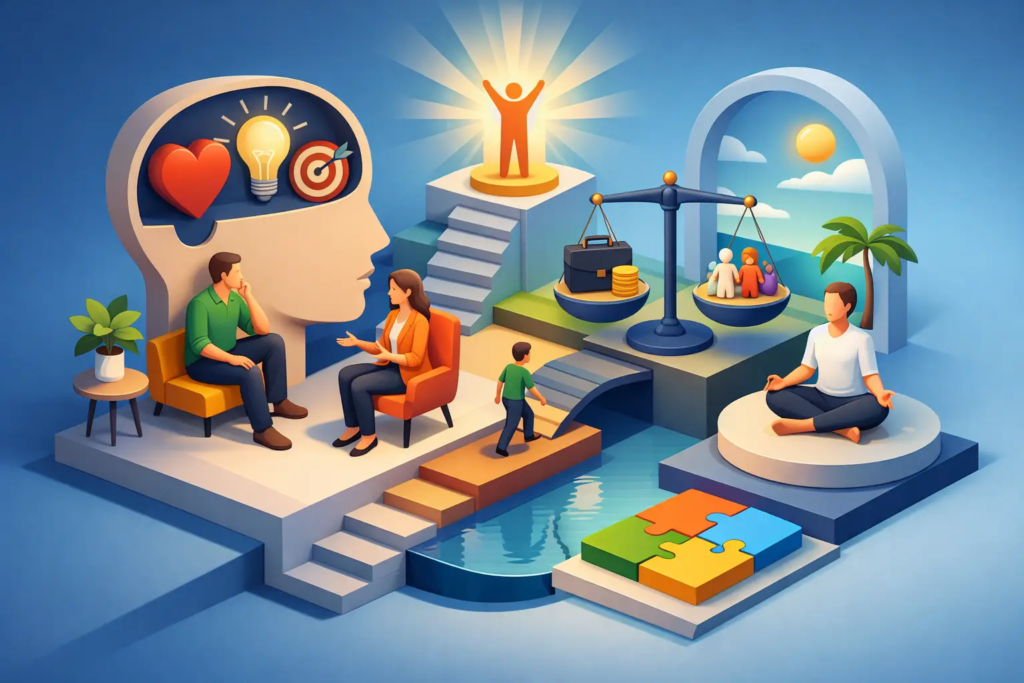
You can look successful on paper and still feel irritated, flat, overextended or strangely unfulfilled. That disconnect is often the real reason high achievers seek support. Human needs coaching addresses what is happening underneath the visible problem – the patterns driving your decisions, your stress, your relationships and your results.
For ambitious professionals, entrepreneurs and leaders, this matters more than most people realise. When your core needs are being met in unhealthy ways, you can end up chasing growth while sabotaging peace, building income while eroding connection, or pushing for performance while draining your energy. The issue is not a lack of capability. It is misalignment.
What is human needs coaching?
Human needs coaching is a transformational coaching approach that helps you understand the psychological and emotional needs influencing your behaviour. Rather than only focusing on goals, habits or surface-level mindset shifts, it looks at why you do what you do.
At its core, this work is based on the idea that people are driven by fundamental needs such as certainty, variety, significance, love and connection, growth and contribution. Everyone values all of them to some degree, but the order, intensity and strategy differ from person to person. That is where things become powerful.
If someone needs certainty above all else, they may avoid risk, over-plan and hold back from expansion. If significance is driving them, they may achieve at a high level but feel emotionally dependent on recognition. If variety dominates, they may struggle with consistency even when they are deeply talented. The pattern is rarely random. It is a strategy.
That is why human needs coaching can create change quickly. Once you identify the real driver, you stop treating the symptom as the problem.
Why high achievers benefit from human needs coaching
Many successful people are already disciplined, intelligent and highly self-aware. Yet self-awareness alone does not always create change. You may know you are overworking, people-pleasing, procrastinating or repeating the same relationship dynamic, but still feel pulled back into it.
This is where a more precise coaching lens matters. Human needs coaching helps explain why the pattern keeps winning. On some level, it is serving you. It may be protecting your identity, giving you control, creating familiarity or helping you feel important. Until that function is understood, behaviour change can remain temporary.
For leaders and entrepreneurs, this work has a direct impact on performance. Your needs shape how you communicate, make decisions, respond under pressure and lead others. They influence whether you micromanage or delegate, whether you seek challenge or avoid exposure, whether you build trust or keep people at a distance.
It also affects your capacity for fulfilment. Plenty of high performers know how to produce results. Far fewer know how to create success that feels grounded, energising and deeply aligned.
The real shifts human needs coaching can create
The strongest coaching does not just help you feel better. It changes the standard from which you operate.
A client who has built their life around certainty may become more decisive, more confident with ambiguity and more open to strategic growth. Someone driven by significance may stop performing for approval and start leading from genuine self-trust. A business owner addicted to urgency may learn how to create momentum without running on pressure.
These are not small mindset tweaks. They affect income, leadership, emotional resilience, relationships and the quality of your day-to-day life.
Human needs coaching can also improve how you set goals. Instead of chasing what looks impressive, you begin choosing outcomes that satisfy both ambition and fulfilment. That is a very different standard of success.
Human needs coaching and burnout
Burnout is not always caused by workload alone. Sometimes it comes from meeting your needs in expensive ways.
For example, if your sense of significance comes from being needed, you may become the person who carries everyone. If love and connection are being sought through over-giving, boundaries can feel uncomfortable. If certainty comes from control, rest may feel unsafe because slowing down means you are no longer managing everything.
This is why practical solutions can fall short. Better time management helps, but it does not always address the emotional driver behind the behaviour. Human needs coaching gets closer to the root. It helps you create healthier strategies for meeting the same needs without sacrificing your wellbeing.
That does not mean ambition disappears. It means ambition becomes cleaner. More intentional. Less driven by stress and more driven by vision.
The link between needs, identity and success
One of the most valuable aspects of this coaching is the way it exposes identity-level patterns. People often say they want more confidence, stronger boundaries or bigger results. What they are often confronting is an old identity that has been organised around survival rather than expansion.
If your identity has been built around being reliable, exceptional, indispensable or emotionally self-sufficient, growth can feel threatening even when you say you want it. You are not just changing behaviour. You are changing who you believe you need to be.
This is where human needs work becomes especially relevant for premium coaching clients. At higher levels of performance, the challenge is rarely information. It is integration. You need a way to align mindset, behaviour, emotional intelligence and energetic capacity so that success is sustainable.
That is why this approach works well alongside business strategy, executive coaching and personal transformation. It helps create internal congruence. When your needs are met in ways that support your future rather than your fear, your actions become far more powerful.
What to expect from a human needs coaching process
A strong coaching process will usually begin by identifying your dominant needs and how they are currently being met. From there, the work often moves into your behavioural patterns, emotional triggers, decision-making style and personal or professional challenges.
This is not therapy, although it can feel deeply revealing. The focus is forward-moving and results-led. The goal is to help you understand what is driving your current reality, then redesign the internal strategies that are keeping you stuck.
That may include changing the way you respond to uncertainty, strengthening boundaries, shifting relationship patterns, releasing dependence on external validation or creating a more empowering meaning around success. In a leadership or business context, it may also involve improving communication, team dynamics, executive presence or strategic focus.
The best results come when this work is not treated as a quick fix. Insight matters, but embodiment matters more. You need to apply what you uncover in real life, especially in the moments where your old pattern would usually take over.
Is human needs coaching right for everyone?
Not always. If someone wants generic motivation or surface accountability, this approach may feel too deep. It is best suited to people who are ready to understand themselves honestly and make meaningful changes.
It is also worth saying that not every coach uses this method with the same level of skill. Human needs work can be transformative, but only when it is handled with precision, emotional intelligence and a clear pathway into action. Insight without structure can leave people fascinated but unchanged.
For high-performing clients, the ideal experience is one that combines deep personal insight with practical strategy. You want change that is measurable, not just emotional. That is where integrated coaching becomes especially effective.
At Hina Solanki Coaching, this kind of work fits naturally within a broader methodology focused on mindset, performance, fulfilment and aligned success. That matters because very few challenges exist in isolation. Your business results, confidence, energy, relationships and leadership capacity influence one another every day.
A better way to define success
Human needs coaching invites a more mature definition of success. Not smaller ambition. Better ambition.
It asks whether your current life is built on true alignment or on coping strategies that happen to look impressive from the outside. It challenges the idea that stress, over-functioning and emotional disconnection are the price of excellence. And it offers a more sustainable path – one where achievement and fulfilment strengthen each other rather than compete.
When you understand your needs, you gain more than self-knowledge. You gain choice. You stop reacting from old programming and start leading your life with clarity, intention and self-trust.
That is where real transformation begins – not when you force harder, but when the way you think, lead and succeed finally matches who you are becoming.