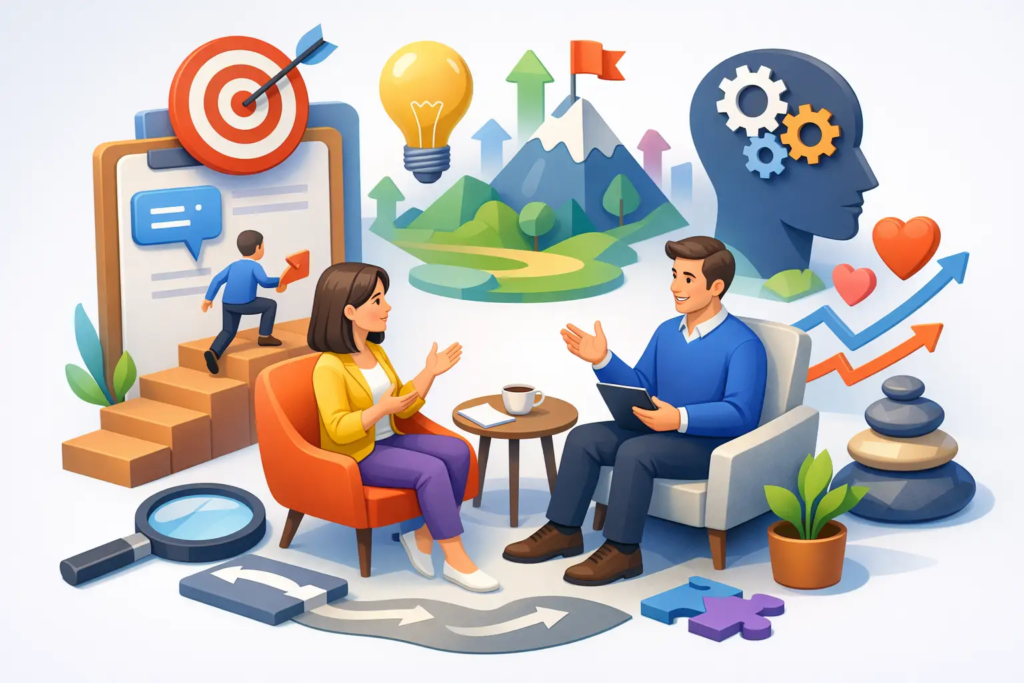
You can be outwardly successful and still know something is off. Perhaps your career looks strong on paper, but your confidence keeps dipping. Perhaps your business is growing, yet your relationships, health, or sense of fulfilment are paying the price. That is usually the point where people start asking, what is personal coaching, and could it be the support that finally creates change that lasts?
Personal coaching is a structured, results-focused partnership designed to help you move from where you are now to where you genuinely want to be. It is not just a space to talk. It is a process that helps you gain clarity, challenge limiting patterns, make stronger decisions, and take consistent action. At its best, personal coaching brings your mindset, behaviour, goals, emotional wellbeing, and energy into alignment so your progress stops feeling like a constant uphill battle.
For high achievers, that matters. When your standards are high, surface-level advice rarely solves the real issue. You do not need another motivational quote. You need insight, strategy, accountability, and the right questions from someone who can see what you cannot.
What is personal coaching in practice?
In practice, personal coaching is a professional relationship built around transformation. A coach helps you identify what you want, why you are not fully achieving it, and what needs to shift for meaningful progress to happen.
That can cover a wide range of areas. One client may want to strengthen confidence and self-worth. Another may need support with leadership, boundaries, burnout, purpose, or decision-making. Someone else may be navigating a life transition, stepping into a bigger role, or trying to create success without sacrificing peace of mind.
The common thread is this: personal coaching is future-focused. It looks at your current reality honestly, but it does not keep you stuck there. The work is about creating movement.
A strong coach will not simply tell you what to do. They will help you think more clearly, see your blind spots, and reconnect with the version of you that can operate at a higher level. Depending on the coach and the methodology, sessions may include mindset work, behavioural change, goal-setting, emotional processing, strategic planning, and accountability.
That last point matters more than most people realise. Insight feels powerful in the moment, but insight alone does not change your life. Coaching closes the gap between what you know and what you actually do.
What personal coaching is not
Personal coaching is often misunderstood because people confuse it with mentoring, therapy, consulting, or simply having a supportive conversation.
It is not therapy. Therapy often focuses on healing past wounds, treating mental health conditions, or processing trauma in clinical depth. Coaching may touch on the past when it is affecting the present, but its primary focus is forward movement and practical change.
It is not mentoring either. A mentor usually shares guidance based on their own experience in a particular field. That can be valuable, but coaching is less about giving you a blueprint and more about helping you unlock your own thinking, direction, and capability.
It is not consulting. Consultants tend to diagnose a problem and recommend solutions. A personal coach may offer perspective and frameworks, but the relationship is designed to strengthen your own self-leadership, not create dependence.
And it is definitely not vague encouragement. Good coaching should produce measurable shifts. Better decisions. Greater confidence. Healthier patterns. Clearer priorities. Stronger performance. More honest relationships. If none of that is happening, it is fair to question the quality of the coaching.
Why ambitious people choose personal coaching
Ambitious people often reach a point where willpower stops being enough. They have discipline, intelligence, and drive, yet they are still hitting the same internal ceiling.
Sometimes that ceiling looks like procrastination, inconsistency, overthinking, people-pleasing, or perfectionism. Sometimes it looks more polished than that. You are performing well, but you are exhausted. You are achieving, but not enjoying it. You are leading others, but second-guessing yourself in private.
Personal coaching helps you identify the deeper pattern beneath the symptom. That is where the real shift happens.
For some, the work is about clarity. They know they want more, but they cannot define what more actually means. For others, it is about confidence and identity. They have outgrown an old version of themselves but have not fully stepped into the next one. For leaders and entrepreneurs, coaching is often about integration – making sure success is not built on stress, self-abandonment, or misalignment.
This is also why personal coaching appeals to people who value excellence. They understand that elite performance is rarely accidental. Whether in business, sport, or leadership, external results improve when internal patterns improve.
The core areas personal coaching can transform
Personal coaching can support almost any area of life, but the strongest work usually sits at the intersection of performance and fulfilment.
Confidence is one of the most common themes. Not performative confidence, but the kind that lets you speak clearly, make decisions faster, hold boundaries, and stop shrinking in rooms you have earned the right to be in.
Mindset is another major area. Many capable people are not being held back by lack of talent. They are being held back by fear of failure, fear of judgement, imposter syndrome, or an old belief that success must come through struggle.
Coaching can also transform relationships. The way you communicate, the standards you hold, the energy you bring, and the boundaries you keep all affect your personal and professional life. When those patterns change, results change too.
Then there is purpose and direction. If you are successful but disconnected from meaning, coaching can help you recalibrate. More achievement is not always the answer. Sometimes the answer is alignment.
That is where a more holistic approach becomes powerful. At Hina Solanki Coaching, for example, personal coaching is not treated as a narrow self-improvement exercise. It is approached as a whole-person transformation, where mindset, strategy, emotional clarity, success, and energy all influence the quality of your results.
How a personal coaching process usually works
Most personal coaching begins with a clear assessment of where you are now and what needs to change. That sounds simple, but it is often more revealing than people expect. You may come in thinking the issue is time management, only to discover the deeper challenge is avoidance, lack of boundaries, or fear of visibility.
From there, coaching sessions create a space for honest reflection and decisive action. You explore patterns, identify priorities, and build a plan that is grounded in your goals rather than somebody else’s definition of success.
A good coach will challenge you, not just support you. They will notice where your language, habits, and choices are out of sync with what you say you want. They will help you interrupt those patterns and replace them with stronger ones.
There is usually accountability between sessions as well. This might include agreed actions, reflection exercises, mindset work, or strategic decisions that need to be made. The purpose is not to create pressure for the sake of it. The purpose is to keep momentum alive.
That said, coaching is not magic. Results depend on the quality of the coach, the honesty of the client, and the willingness to act. If you want transformation but resist discomfort, progress will be limited. Growth often requires you to release familiar patterns, even when those patterns are no longer serving you.
Is personal coaching worth it?
It depends on what you want and how ready you are for change.
If you are looking for someone to rescue you, probably not. If you want instant answers without self-examination, probably not. But if you are willing to be coached, willing to be honest, and willing to back your own growth, personal coaching can be one of the most valuable investments you make.
Its value is not just in helping you hit one goal. The deeper value is that it changes how you think, decide, lead, and respond under pressure. Those shifts affect every area of life.
For professionals and entrepreneurs, the return can be significant. Better leadership, stronger communication, cleaner decision-making, improved confidence, and more consistent performance all carry real personal and commercial value. On the human side, coaching can also bring relief – less internal noise, less confusion, and less living beneath your potential.
How to know if you need personal coaching
You probably do not need coaching because everything is falling apart. More often, people need it because they are ready for more than their current patterns can deliver.
If you feel stuck, stretched, frustrated, or quietly underfulfilled, pay attention. If you know you are capable of more but keep circling the same problems, pay attention. If your success looks impressive from the outside but does not feel sustainable on the inside, definitely pay attention.
The right coaching relationship can help you create stronger results, but it can also help you create them in a way that feels cleaner, calmer, and more aligned with who you are becoming.
Personal coaching is not about fixing a broken person. It is about expanding a capable one. And sometimes the fastest way forward is not working harder alone, but allowing the right support to sharpen your vision, strengthen your thinking, and call you into the level you are truly meant to lead from.